
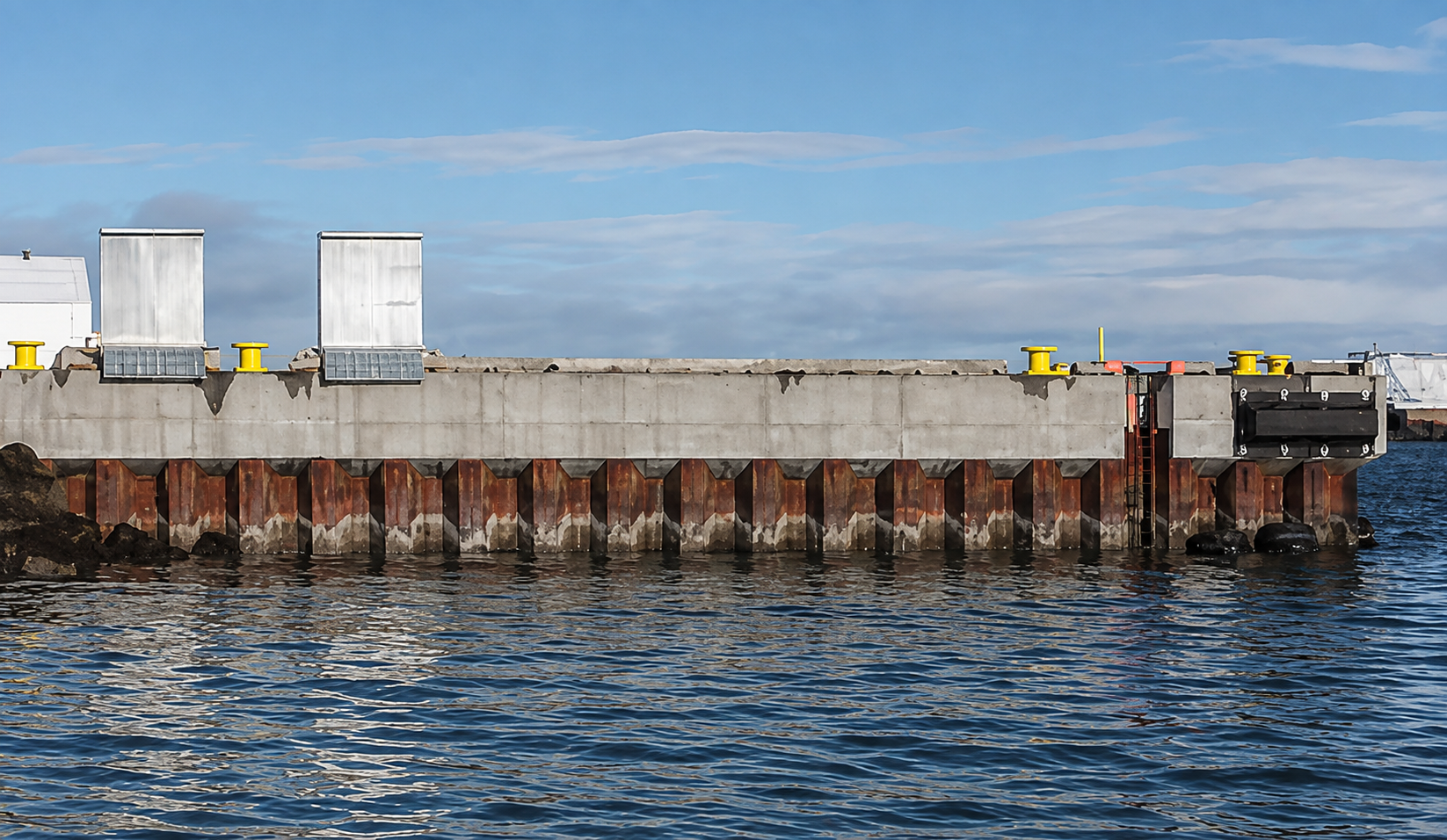
Extending the Service Life of Quay Walls Through Monitoring
SUPPORT & COOPERATION
Machinist Ltd
Factories
Häme University of Applied Sciences (HAMK)
Kajaani University of Applied Sciences
Foreign governments
Other institutions
CORPORATE TRAINING PLATFORM
- A corporate training platform refers to a software designed to offer various training tools and resources. These resources can encompass further professional education and virtual training. This platform represents a progressive step forward in the realm of corporate training.
- Corporate learning platform encompasses training programs created by companies to educate their stakeholders on new processes, tools, technical skills, and other essential knowledge to align with current market trends. This platform refines and empowers the stakeholders, equipping them to efficiently tackle tasks and meet the demands of the business. We are especially targeting engineers in developing markets within Central Asia, South Asia, the Caucasus Area, and further on Latin America. These markets cover huge geographical areas but infrastructure-wise leaving continuous growth and development. The local workforce is in demand to broaden their vision to international projects.
- Without exaggeration, Finland, the Netherlands and neighboring countries are the world leaders in the industry of foundation and ground construction with innovative piling technologies. The area possesses a high level of know-how in this field.
EXPANSION INTO FOREIGN MARKETS IN DEVELOPING COUNTRIES
Example: Challenges in Central Asia
Low cost of human labor
Due to the low cost of labor in the area, modern building technology and machine usage are being adopted gradually. The majority of workers on modern building projects are manual laborers, which results in low industrialization. New machinery are needed as soon as new construction approaches are adopted, which is both a difficulty and an opportunity.
Cultural mindset
In post-Soviet countries, the responsibility for infrastructural construction, development, and architecture is outsourced to so-called "Project Development Institutes." These institutes are partially private but mainly are government entities responsible for studying and implementing all innovations that are approved as legislation and used on the job sites. As a result, construction methodologies in the Project Development Institutes of the region are old and follow post-Soviet structure. The local engineering force, due to their old age, requires a lot of education about new technologies, modern ways of ground construction, and the use of new machines.
Safety requirements
The recent earthquake in Turkey has led to a surge of awareness regarding foundation construction and safety in seismic areas. In Central Asia, where a lot of ambitious projects are about to evolve drives demand for knowledge and international experience. This has resulted in local professionals actively seeking new solutions and knowledge to ensure the safety of their own construction projects.Absence of active know-howIn this market, there are no other competitors offering the same type of service to customers. Therefore, our online "University" will offer a unique value proposition to promote our know-how and machinery in the target markets. By providing access to the latest knowledge and industry insights, we can help local professionals stay ahead of the curve and meet the demands of the industry. This will not only benefit our business but also contribute to the overall economic growth and development of the region.
Industrialization level
Lower rate of technological usage in terms of machines and equipment. A lot of steps in the process are completed in an old-fashioned way. High demand in infrastructural construction requires knowledge and implementation of modern technology.
Join our newsletter!